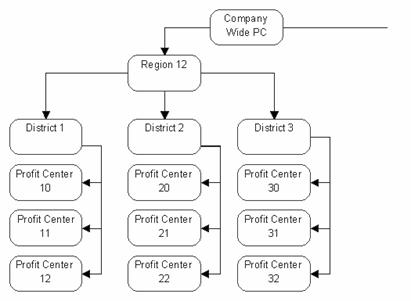
A path consists of a hierarchy of levels with each profit center in the level serving as a "parent" to the level below it and as a "child" to the level above it. The company wide profit center will serve as the top most level in the hierarchy and serve as both parent and child to itself. There are any number of methods you can use when creating paths. One common method is to create paths based on store, district, and region, respectively.
These paths make it possible for you to consolidate financial information from the bottom of the path up and distribute overhead from the top of the path down. Consider the following example.
In this example, Districts 1, 2, and 3 and region 12 must be designated as profit centers. If no "actual" profit center exists at these levels, you must create dummy profit centers. For example:
· Create a "dummy" profit center for District 1 to serve as the parent profit center to profit centers 10, 11, and 12.
· Create a "dummy" profit center for District 2 to serve as the parent profit center to profit centers 20, 21, and 22.
· Create a "dummy" profit center for District 3 to serve as the parent profit center to profit centers 30, 31, and 32.
· Create a "dummy" profit center for Region 12 to serve as the parent profit center to profit centers "district 1", "district 2," and "district 3"
The company wide profit center serves as the parent profit center for profit center "Region 12".
ExecuTrak provides you with two methods for distributing over head in a consolidation path:
· Direct Method
· Indirect Method
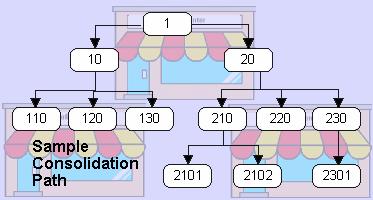
If you use the direct method for distributing overhead, the system will distribute overhead in a cascading manner so that each profit center's overhead is distributed to those profit centers directly below it in the consolidation path. The allocation weight tells the system what percentage will be distributed to each ProfitCenterbelow a designated "Parent" profit center.
· All overhead will be distributed from the parent profit center to the next level of profit centers beneath the Parent in the consolidation path. In the following consolidation path. Profit centers 110, 120, 130, 2101, 2102, 220, and 2301 will eventually receive all the overhead from the Profit Centers above them. No overhead will remain in Profit Centers 1, 10, 20, 210, and 230.
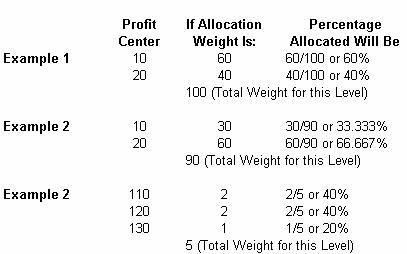
· With the direct method of distributing overhead, the Allocation weight determines the percentage of overhead distributed to each profit center. ExecuTrak will take one level at a time and total the allocation weights entered for all profit centers at that level. In order to compute the percentage of allocation that each profit center will receive, the system takes the allocation weight entered for each individual profit center on that level and divides it by the total of the allocation weights for that level. Review the following examples.
This base method of allocation distributes overhead to only the lowest level profit centers in the path. These are profit center that are not designated as a "Parent" of another ProfitCenter). All profit centers between the designated "Parent" ProfitCenter(from which to distribute the overhead) and the "Base" profit centers will be omitted from the allocation process. However, You must still assign Allocation Weights for the Base Profit Centers as described in the previous example.