The Data Alerts File Maintenance program lets the DataTrak administrator perform the following functions:
Specify which alerts a user will receive.
Assign each user/alert combination to a schedule; in turn, the schedule determines the frequency with which the user will receive the alert. Schedules are specific to the alert, not the user.
Set the tolerance for each user/alert.
Modify existing user/alert combinations.
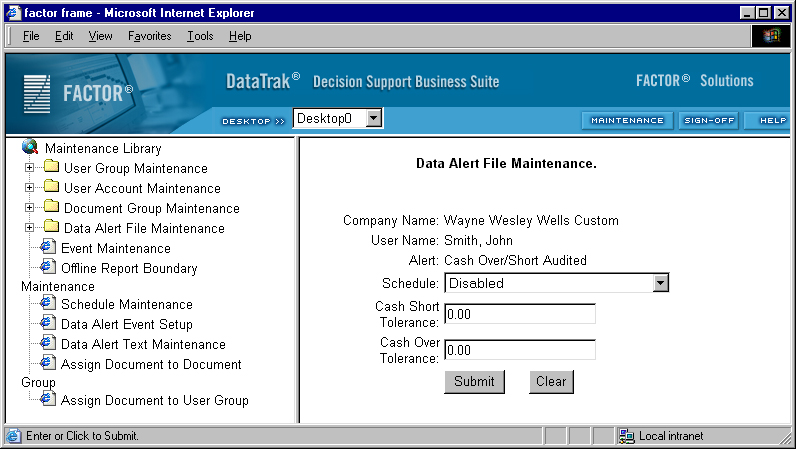
The DataTrak administrator can add or edit alerts for all users. An individual user can create or edit only his or her own alerts. See the following sample Data Alert File Maintenance screen:
Use the following procedure to assign a data alert/schedule to a user.
Login to DataTrak as "admin".
Click the Maintenance option on the DataTrak menu. The browser displays the DataTrak Maintenance screen. The left pane displays the DataTrak Maintenance Library tree and the right pane displays the most common DataTrak Maintenance instructions.
Click the Data Alert File Maintenance folder in the Maintenance Library to expand it and to display a list of DataTrak users.
Click the user name for which you want to assign a data alert.
The right browser pane displays the database selection field. To specify the company, click the down arrow next to the field and select the company from the dropdown list. Click the database to select it.
After you select the database, click the Submit button.
The system displays
the alert selection field. Click the down arrow next to the field to display
a list of data alerts. Click the alert in the list to select it.
Note: Data alerts are pre-defined by Factor. Users cannot define alerts.
After you select the alert, click the Submit button. The system displays the schedule and tolerance fields.
Click the down arrow next to the schedule field to select from a pre-defined list of schedules. The schedule will specify the time and/or frequency with which the identified alert will be sent. Each alert can be assigned a different schedule.
The tolerance for
each alert defaults to zero. The tolerance identifies the amount of deviation
required for triggering an alert. For example, the Unaudited Cash Over/Short
alert allows you to enter a tolerance for cash over and a tolerance for
cash short. If you set the tolerance for each of these to 5.00, then the
system will send an alert whenever the cash over or cash short exceeds
5.00. If the unaudited cash over/short for a report equals 3.35, then
no alert is sent since the amount is less than 5.00.
After you enter the tolerance for the alert, click the Submit button
to save the record.
After the record is saved, the left pane returns to the Database Selection field and allows you to define another alert.